
Ordering the wrong boom lift for a job site isn’t just inconvenient — it’s expensive. Understanding the different types of boom lifts before making a decision can mean the difference between a productive project and a costly mistake.A straight boom that cannot reach over obstacles will sit idle on a congested construction site. A heavy-duty diesel lift delivered to a sensitive indoor facility creates noise complaints and ventilation nightmares. A towable unit that barely reaches the required height becomes a daily bottleneck.
The cost of a mismatch goes deeper than the rental or purchase price. Every hour a machine sits idle is billable labor standing around. Every time a crew improvises with the wrong equipment, safety margins shrink. And when a lift gets returned early because it cannot do the job, you lose more than money — you lose credibility with your client.
Boom lifts — also called cherry pickers — use a hydraulic arm to elevate workers in a platform basket. Unlike scissor lifts that move only vertically, boom lifts provide both vertical reach and horizontal outreach. The boom arm extends, retracts, and — in articulating models — bends at jointed knuckles, allowing the platform to go up, out, over, and sometimes under obstacles.
Whether you are a rental fleet manager expanding your inventory, a contractor tackling multi-story construction, or a facility maintenance team servicing overhead infrastructure, understanding the available types is the first step toward putting capital into equipment that actually earns its keep. Here is the complete breakdown.
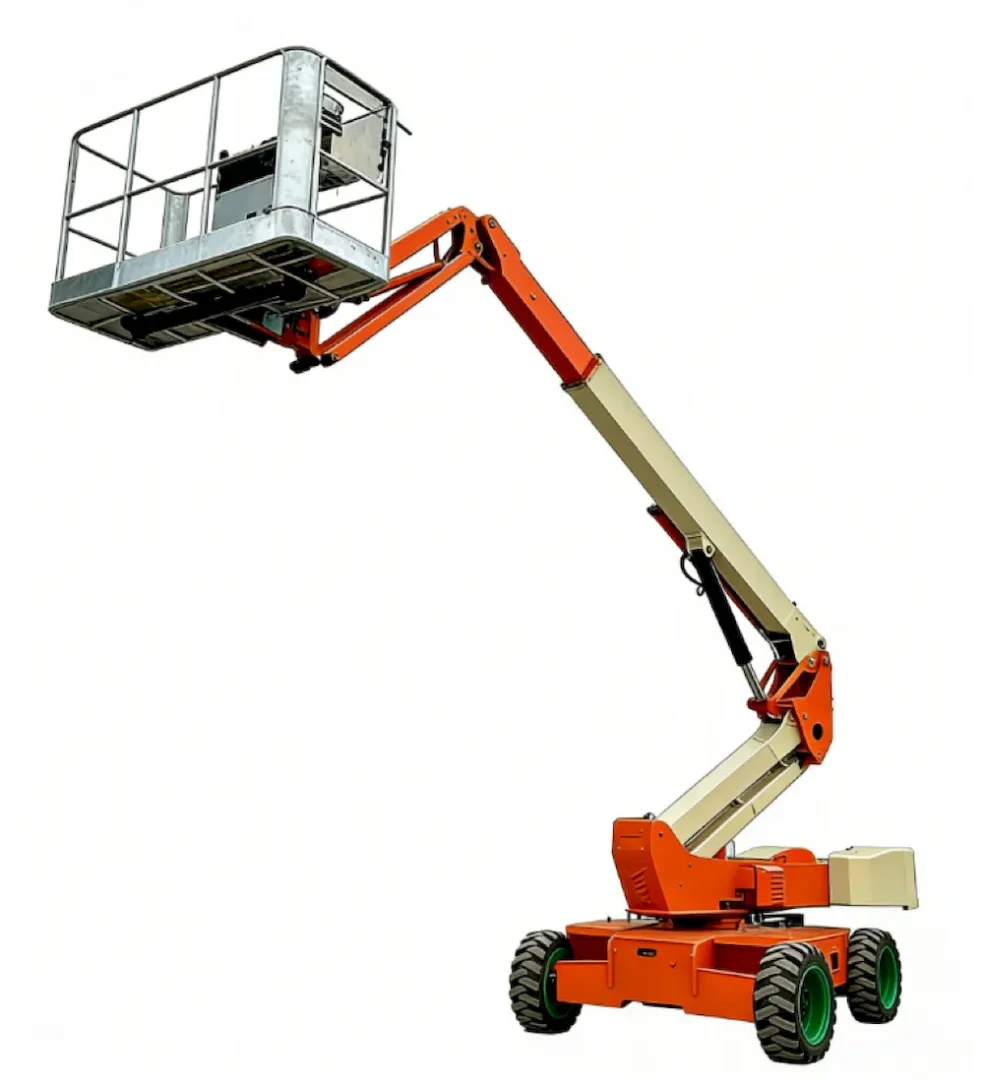
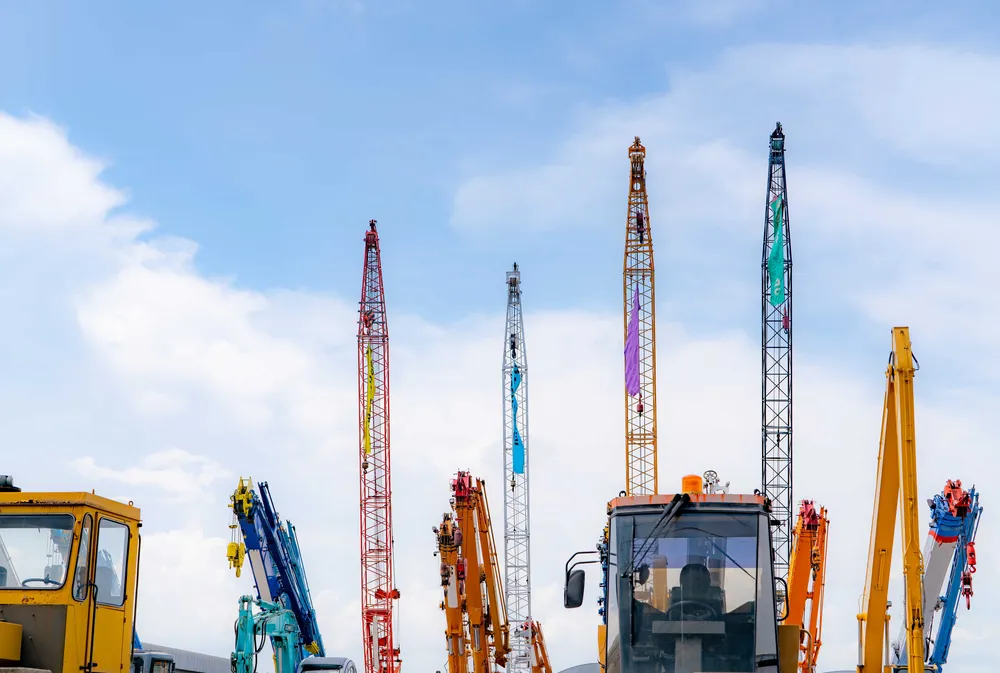
A straight boom lift extends and retracts in a telescopic motion — a hydraulic arm that slides outward section by section. The boom extends directly forward and upward, offering maximum vertical reach with minimal articulation. Most models feature a rotating turntable (typically 360°) on a wheeled chassis.
Key parameters: Platform height: 14–41 m | Working height: 16–43 m | Horizontal outreach: 9–24 m | Load capacity: 230–450 kg | Power: Diesel (most common), electric and dual-fuel options available
Typical applications: Straight booms excel on open construction sites, steel erection, bridge inspections, and wind turbine maintenance. They cover the tallest working heights in the aerial lift category, making them the default choice for high-rise construction and industrial facility maintenance where obstacles are minimal. Because the boom extends in a fixed direction, the operator needs a clear line of sight — these machines need more floor-level maneuvering space than articulating models. On the plus side, the telescopic design provides exceptional platform stability at full extension with minimal bounce.
Best for: General contractors, steel erectors, and industrial maintenance teams needing maximum height with predictable, straight-line access.
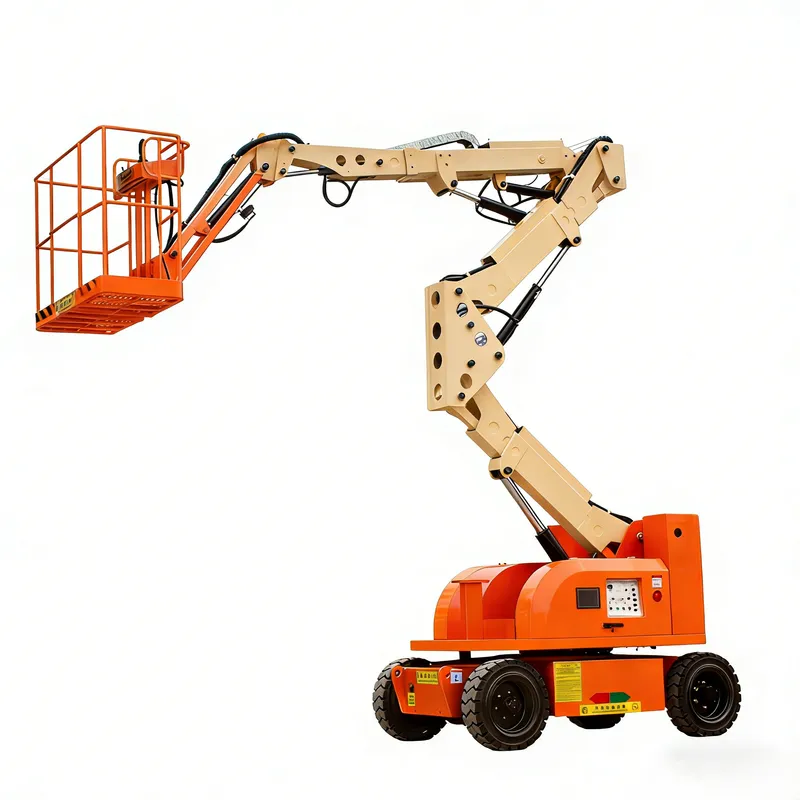
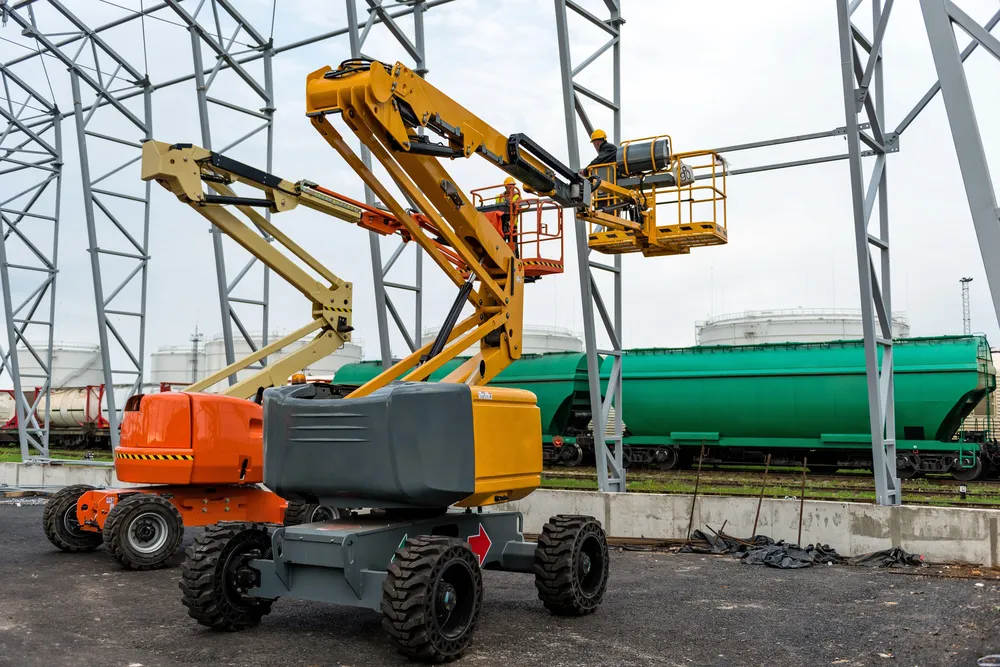
Articulating boom lifts feature a multi-section boom connected by pivot joints — “knuckle booms.” These joints let the platform bend and maneuver around obstacles, reaching up, over, under, and between structures that a straight boom cannot access. Most models include at least two articulated sections (primary boom and jib).
Key parameters: Platform height: 16–30 m | Working height: 18–32 m | Up-and-over outreach: 7–12 m | Load capacity: 230 kg (standard), heavy-duty models to 350 kg | Power: Diesel, electric, and dual-fuel widely available
Typical applications: Articulating booms are the go-to solution for congested job sites — working around steel frameworks, inside partially completed buildings, beneath bridge decks, and over stored materials. Common users include HVAC contractors routing ductwork through structural gaps and maintenance crews servicing equipment behind architectural features. The tradeoff for maneuverability is reduced maximum height — at comparable price points, an articulating boom reaches roughly 30–40% less vertical height than a straight boom. Most modern models include envelope control systems that prevent tip-over during complex maneuvers.
Best for: Facility maintenance teams, HVAC and electrical contractors, and any project where obstacles stand between the machine and the work area.
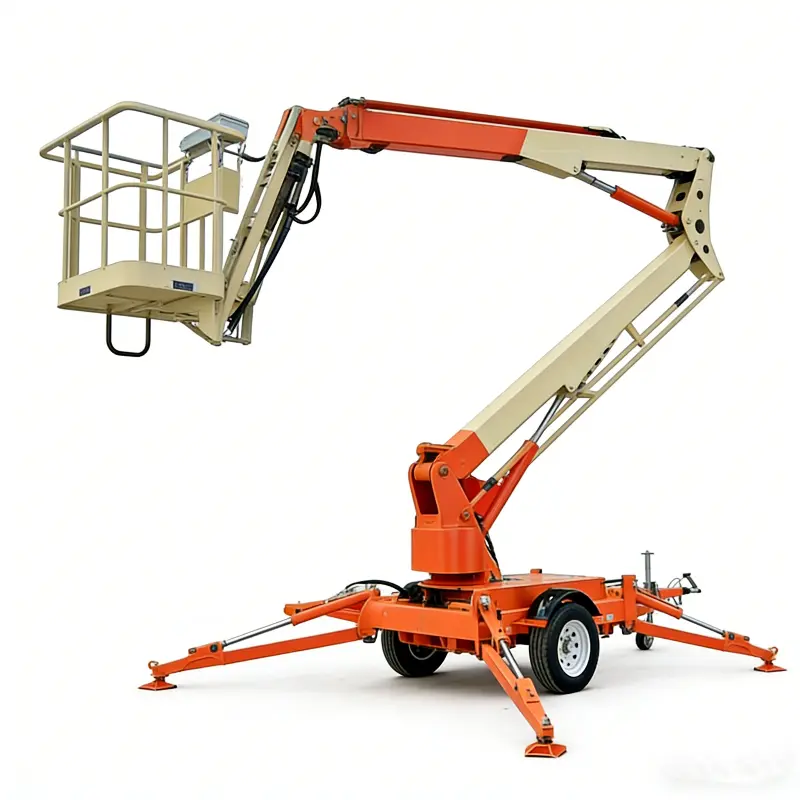
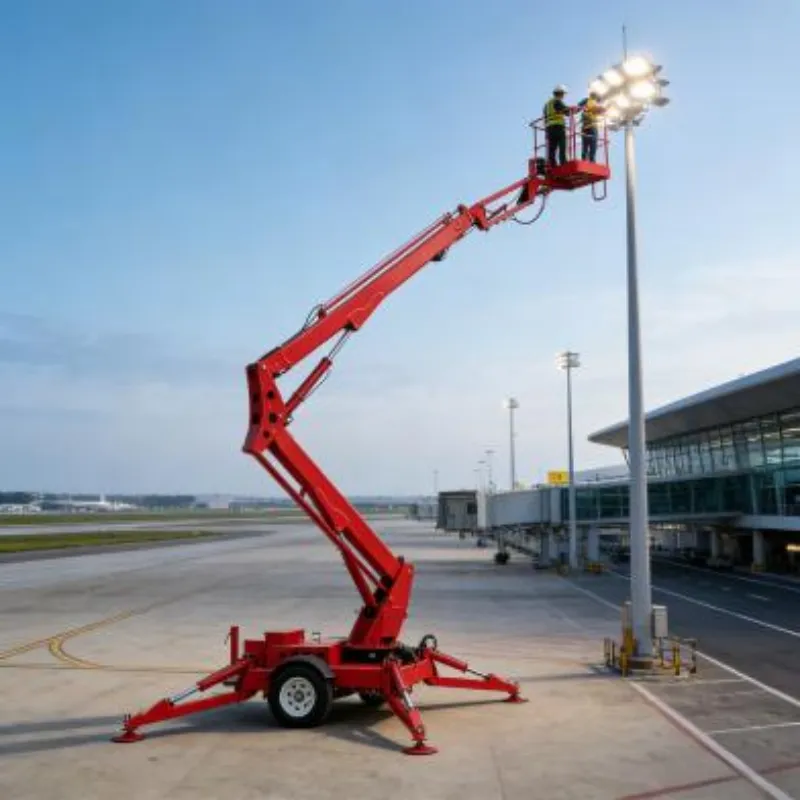
Towable boom lifts are lightweight, trailer-mounted units hitched to a standard vehicle and towed between job sites. They deploy stabilizing outriggers on arrival and combine compact transport dimensions with respectable working heights. Most use an articulating or telescopic-articulating hybrid boom design.
Key parameters: Platform height: 8–24 m | Working height: 10–26 m | Horizontal outreach: 6–12 m | Load capacity: 200 kg | Towing weight: Under 3,500 kg | Setup time: 2–5 minutes
Typical applications: Towable booms serve small contractors, signage installers, tree surgeons, and building maintenance companies moving between multiple jobs daily. A single operator can tow, deploy, and be working at height within minutes — no flatbed truck or specialist transport needed. Popular in the residential and light commercial sector: gutter cleaning, exterior painting, window installation, and roof repair. Once outriggers are deployed, the machine is stationary — every work position requires a full setup cycle. Outriggers need firm, level ground; wind sensitivity is higher than self-propelled models due to lighter weight.
Best for: Small to medium contractors who want a single machine that travels easily and handles mid-height outdoor tasks without dedicated transport.
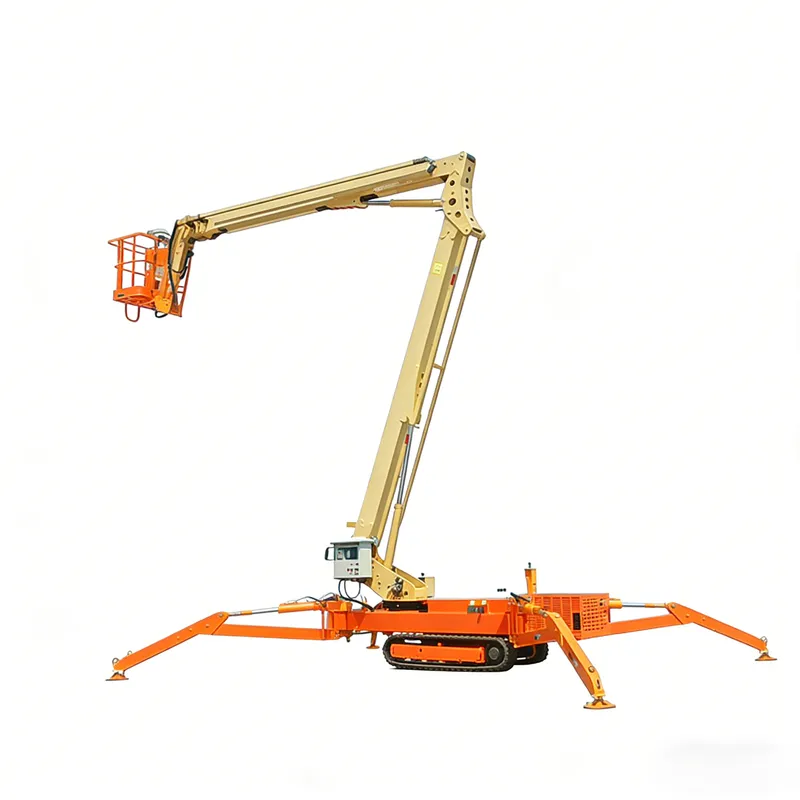
Crawler boom lifts replace wheels with rubber or steel tracks, providing the ground pressure and grip of tracked machinery. They combine an articulating or telescopic boom with a tracked undercarriage for operation on soft soil, mud, snow, and steep gradients where wheeled lifts would bog down.
Key parameters: Platform height: Up to 25 m | Working height: Up to 27 m | Load capacity: 200–230 kg | Gradeability: Up to 30° | Ground pressure: 0.3–0.5 kg/cm² (vs. 4–8 kg/cm² for wheeled equivalents) | Width: Many compact models under 1 m
Typical applications: Crawler booms handle tough terrain — pipeline construction on soft backfill, forestry maintenance on sloped ground, railway work on ballast and embankments. A unique subclass is the compact crawler boom, narrow enough for standard doorways and light enough for passenger elevators, transitioning from outdoor rough terrain to indoor finished floors on the same job. Tracked undercarriages are slower than wheeled chassis (1–3 km/h vs. 5–7 km/h). Track tension must be monitored — loose tracks derail on turns, over-tightened tracks accelerate component wear.
Best for: Civil engineering contractors, utility maintenance crews, and any team working where traction and flotation are non-negotiable.
The power source determines where you can use the lift, what it costs to run, and what maintenance it needs.
Diesel engines are the workhorse of outdoor construction. They deliver high torque, 8–12 hours of continuous runtime per tank, and reliable cold-weather starting. The tradeoffs: 80–90 dB noise, exhaust emissions requiring ventilation, and higher maintenance (engine oil, filters, DPF on Tier 4 models). Diesel is the default for open construction sites and infrastructure projects.
Electric (battery) lifts offer zero emissions and low noise — under 70 dB, quiet enough for occupied buildings. They are the only option for indoor facilities, hospitals, and food plants. Runtime is 4–8 hours per charge, declining as batteries age. The major limitation: battery capacity drops 30–50% in sub-zero temperatures, making electric lifts unreliable for outdoor winter work.
Dual-fuel models run on both gas/LPG and battery, offering the broadest flexibility — indoors on battery, outdoors on gas. The gas engine provides 6–10 hours per tank at 75–85 dB. The downside: maintaining both an engine and a battery system means more maintenance than either single-source option. Dual-fuel is popular for rental fleets serving diverse customers.
Key rules: If any portion of work is inside a finished building, electric is mandatory — diesel exhaust in enclosed spaces is a health hazard and regulatory violation. Dual-fuel models offer the broadest fleet appeal because they work on battery indoors, on gas outdoors.
A common question: “Should I get a boom lift or a scissor lift?” They solve fundamentally different problems.
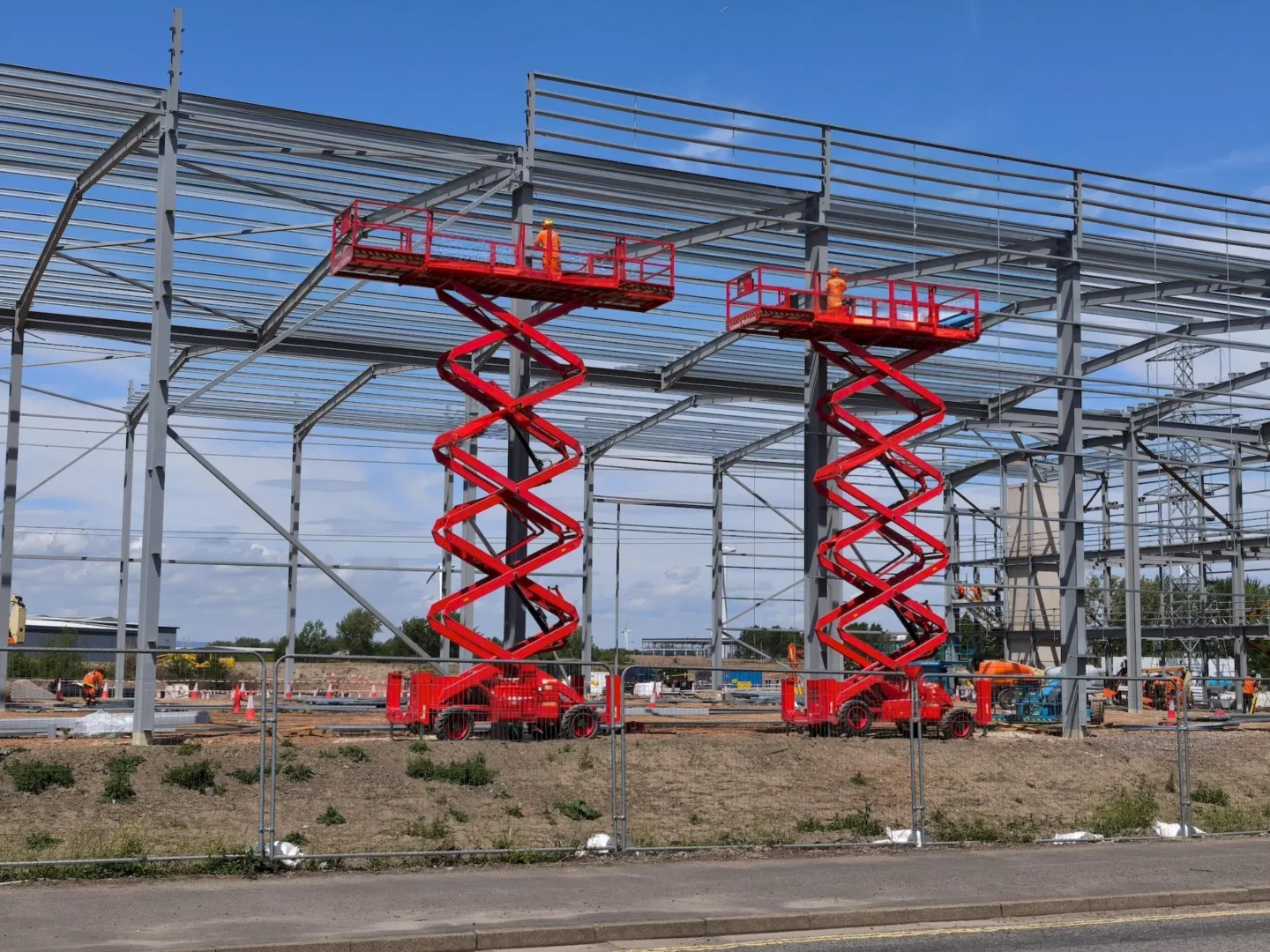
Boom lifts move vertically and horizontally, reaching up to 43 m working height. Their platforms are smaller (1–2 people, 200–450 kg) and articulating models can navigate around obstacles. Scissor lifts move vertically only — straight up, straight down — topping out around 18 m. However, the platform is larger (2–4 people plus materials, up to 1,000+ kg) and cost per meter of height is lower.
The practical rule: Need to carry multiple workers and heavy materials straight up to one work plane? Scissor lift. Need to reach over, around, or under obstacles at varying heights? Boom lift.
Now that you know the types, the next step is matching them to your specific project conditions. Our companion guide — How to Choose the Right Boom Lift — walks you through the four key questions (height, obstacles, ground, and load), common buying mistakes to avoid, safety features to verify, and a decision framework you can apply to any job.
East Lifting manufactures a full range of boom lifts — from compact towable units to large straight booms reaching over 40 meters, from electric articulating models for indoor precision work to crawler booms that handle the toughest terrain. Every machine is CE and ANSI certified, backed by 20 years of manufacturing expertise.
[Explore East Lifting’s boom lift range →] (Link to: https://eastlifting.com/product-category/boom-lifts/)